
 Remember when fixing technology meant blowing into a Nintendo cartridge?
If the game refused to start, you pulled it out and blew on it. If that didn’t work, you tried again. Sometimes you even tapped the console and hoped for the best.
At the time, that felt like real technical troubleshooting. Technology was simpler back then, and most of us believed we were pretty good at handling it.
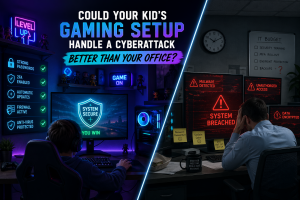
Now fast-forward to today and look at your kid’s gaming setup.
Their computer probably runs on a fast solid-state drive. It has plenty of RAM, a powerful graphics card, and a processor capable of handling demanding software. Their Wi-Fi covers the whole house without dead zones. Their accounts are protected with multi-factor authentication. Updates install regularly and performance monitoring tools track how everything runs.
In short, their system is optimized.
Now take a moment and think about the technology in your office.
There might be a workstation from several years ago that takes forever to boot up. A printer that jams more often than it prints. Shared folders filled with files named things like “Final Version,” “Final FINAL,” or “Use This One.”
Your team might use several software platforms that don’t communicate with each other. The Wi-Fi signal might disappear in certain rooms. And somewhere in the office there is almost certainly a laptop showing a “Restart to update” notification that someone keeps ignoring.
Gamers optimize their technology.
Businesses often tolerate theirs.
That gap quietly costs companies far more than most people realize.
Why Gamers Often Manage Technology Better
The difference usually is not money.
A good gaming computer often costs about the same as a business workstation. Business internet plans are typically faster than home connections. The tools needed to monitor and secure a network are widely available and not especially expensive.
The real difference comes down to attention.
Gamers update everything right away. They install operating system patches, driver updates, firmware upgrades, and application updates the moment they become available. They do it voluntarily because outdated software causes lag, and lag ruins the experience.
Many gamers will stay up late just to install a new update before the next gaming session.
Meanwhile, in many offices those same updates get postponed again and again.
Every postponed update represents a known security vulnerability. Developers already discovered the problem and released the fix. The only thing missing is installing it.
Gamers also take backups seriously.
Anyone who has lost hours of game progress knows that pain. After it happens once, they make sure their data stays protected.
Yet many small businesses operate without a clearly documented disaster recovery plan. If a gamer loses data, they replay part of a game. If a business loses data, it may lose client records, financial information, or operational systems.
Gamers also monitor performance constantly.
They watch CPU temperatures, frame rates, storage usage, and network latency. If something slows down slightly, they notice immediately and start troubleshooting.
Most businesses discover performance problems when an employee says, “The internet seems slow today.”
That is not monitoring. That is waiting for someone to complain.
Your kid would never run their gaming system that way, and their computer is not responsible for keeping a business running.
How Business Technology Gets This Way
Most companies don’t intentionally build messy technology systems. Instead, systems grow gradually.
A new tool gets added to solve one problem. Later another platform gets introduced for accounting. Then a CRM appears to manage customer relationships. File sharing tools arrive. Payroll software gets installed. Security software gets layered on top.
Each addition makes sense at the time.
Over the years, however, technology stops being intentionally designed and starts being accumulated. Accumulation leads to inefficiency.
Gaming setups are designed with performance in mind from the beginning. Business systems often grow piece by piece based on immediate needs.
One approach is strategic and the other happens by accident. Eventually accidentally built systems become expensive systems.
Years ago, when technology meant blowing dust out of cartridges, we simply didn’t know any better. Today the knowledge and tools exist to build efficient technology environments.
The real question is whether anyone is paying attention.
The Hidden Cost of Small Technology Problems
Most businesses do not experience massive system failures. They deal with small daily interruptions.
A slow login here. A missing file there. Data that must be entered into two different systems. Computers that require frequent restarts. Manual processes that exist because software systems do not integrate.
Each problem seems small.
However, research from the University of California Irvine found that it takes about 23 minutes to regain full focus after an interruption.
That means a five minute technology problem rarely costs only five minutes. The real cost is closer to thirty minutes.
Multiply that across multiple employees and an entire year and what once looked like a minor inconvenience becomes hundreds or even thousands of lost work hours.
In gaming, lag is unacceptable. In business, lag slowly becomes normal and “normal” can be extremely expensive.
A More Important Question
When business owners talk about technology, many say something like, “Everything works fine.”
But working and working efficiently are very different things.
Ask yourself a few questions:
Do your tools integrate smoothly, or do they simply exist alongside each other?
Do your systems support your workflow, or do employees constantly work around limitations?
Is someone actively monitoring your network performance before problems happen?
Or do you only hear about issues when employees start complaining?
Hardware is only one part of modern technology environments. Software integrations, automation, security systems, and workflow design all play major roles in productivity.
Those improvements rarely happen automatically and someone needs to evaluate and maintain them.
A Quick Technology Reality Check
Take a moment to answer a few simple questions.
Do you know when the oldest computer in your office was purchased?
Do you know whether your backups ran successfully last week?
Is there currently a device on your network ignoring update notifications?
Could you quickly tell someone the speed of your office internet connection?
Your kid could probably answer all of those questions instantly about their gaming computer.
If you can’t answer them about the systems your business relies on, that does not mean something is wrong. It simply means no one has been watching closely.
Fortunately, that problem is fixable.
How We Help Businesses Improve Their Technology
We help companies move from technology accumulation to technology optimization.
That means stepping back and evaluating everything together. Hardware, software, security, workflows, and the systems that support daily operations.
Our goal is not to add more technology. Our goal is to help your existing technology work better.
When systems work well and run smoothly, employees spend less time fixing issues and more time growing the business.
If you would like to review how your current systems support productivity and profitability, we are happy to talk.
No technical jargon. No pressure. Just a practical conversation about how your technology environment functions today and how it could improve.
If reading this made you think about another business owner who may be tolerating unnecessary technology problems, feel free to share it with them.
Because in business, just like in gaming, performance matters.